
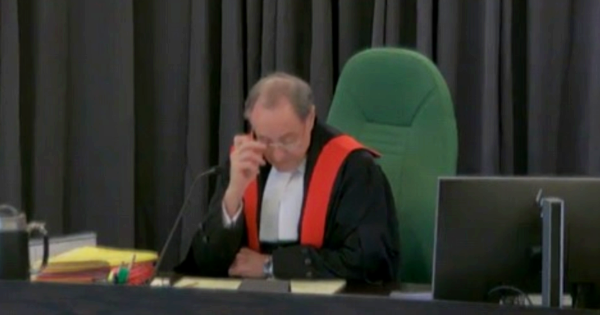
Judge Warren Zimmer at The Lionel Desmond Inquiry. Photo: NS Courts/Twitter
Was Cpl. Lionel Desmond a victim of a foreign war, systemic racism and siloing of medical records, or was he a perpetrator of domestic violence who murdered the women closest to him? And how do we reconcile it if he was both?
— Aaron Beswick
Saltwire Network
April 20, 2022
I don’t envy Warren Zimmer’s next few months.
After 55 COVID-stuttered days of hearings over two years, 69 witnesses, and countless exhibits and submissions, Zimmer, a veteran provincial court judge appointed more than four years ago to preside over the Desmond inquiry “in accordance with subsection 27(3) of the [Fatality Investigations] act,” must now begin by definitively answering those — and many other — questions.

There are few questions about what happened inside a house in remote Upper Big Tracadie, Nova Scotia, on January 3, 2017. Afghanistan war veteran Lionel Desmond murdered his 31-year-old wife, Shanna, their 10-year-daughter, Aaliyah, and his 52-year-old mother, Brenda, and then he took his own life with a rifle he bought legally that day.
The first question would seem to be why? Answering that question, we hope, will lead to recommendations and changes that can prevent such tragedies from happening again. That’s the real purpose of Zimmer’s inquiry.
But an answer to that big why — as we discovered last week during closing submissions by those representing the various “interested parties” — is slippery, and it only leads to many more whys. And those whys may simply divert us from the “whats” that need to change — whether it be support for victims of domestic violence, treatments for those suffering from PTSD, or culturally appropriate mental health services.
Consider the discussion of the role of domestic violence in this murder-suicide.
Noting a video showing an apparently calm Desmond buying a rifle at an outdoors supply store hours before the killings, Thomas MacDonald, the lawyer representing the parents of Desmond’s wife, Shanna, declared:
Mr. Desmond’s actions were planned, they were deliberate, they were pre-meditated, they were homicidal, they amounted to domestic abuse and intimate partner violence.
亚当•罗杰斯律师翅ting Lionel’s sister, Cassandra, on the other hand, saw “violence in a domestic context but not domestic violence…”
The real question here is, what was it about seven months in a war zone, or perhaps the Afghanistan War zone in particular, that changed this fountain of positivity and many others like him into someone who was impatient, deeply depressed, paranoid, cognitively impaired and ultimately saw no other way out… The underlying causes must be recognized as well the limitations on the free will of someone with multiple concussions and complex dissociative post-traumatic stress disorder. The real Lionel Desmond did not commit these acts.
Who was the real Lionel Desmond? How did what he experienced in Afghanistan affect his mental health, his relationships with his wife and family? And could that have ended differently?
Tara Miller, a lawyer who represented another Desmond sister, Chantel,focused on systemic failures and racismas key factors that led to the tragedy.
Desmond, who had been diagnosed with PTSD and major depression following a brutal 2007 tour of duty in Afghanistan, was medically discharged from the military in 2015 but without any clear plan for his future mental health treatment and care.
Veterans Affairs, for example, took six months to appoint a case manager to help him navigate civilian health care bureaucracy. Worse, those trying to treat Desmond after his release had no access to the military medical records that underscored Desmond’s complex mental health issues.
These deaths were the tragic result of the failures of multiple service providers and institutions … to share and take action on meaningful information in a timely way, or at all.
But Lori Ward, a lawyer representing the federal Attorney General,made the case that it would have been wrongfor health care providers to “throw privacy to the wind.”
卫生保健提供者confidentiali职责ty. They cannot be reaching out to family members arbitrarily to obtain or disclose personal information without the consent of the patient.
Roderick Rogers, a lawyer representing Nova Scotia Health agreed, suggesting that eliminating existing restrictions on sharing medical information without a patient’s consent might result in those with mental health issues being more reluctant to seek help. “We want more people seeking help, not less.”
Ward also attempted to counter the criticism of federal health care providers by pointing to the above-and-beyond role of Marie-Paule Doucette, the over-worked, under-staffed social worker who ultimately did act as Desmond’s caseworker, personally driving him to the airport so he could enter an inpatient treatment program, offering to meet with him on her vacation, and attempting “to help him solve daily stressors, all with compassion and empathy.”
[She] is one example of a caring team of Veterans Affairs case managers and service team members who work hard for their clients every day in challenging circumstances. … a person who went out of her way for Mr. Desmond and yet she was asked [by counsel at the inquiry] if she felt ‘contrition’ after he killed his family. Are you kidding me?
And then there was — and is — the over-arching issue of race and racism. Lionel Desmond was Black. Miller made the argument that it is impossible to consider Desmond’s mental health issues without acknowledging the system’s failure to provide treatment in a “culturally responsive manner.”
For Cpl. Desmond to be properly treated … there needed to have been culturally responsive care provided by clinicians trained in cultural competency. It’s not clear if Cpl. Desmond received this care … Certainly, none of the treatment providers were Black.
At one level, it may seem important to untangle all these tangled threads of trauma, mental illness, domestic violence, and racism that ultimately led to the horrific events of January 3, 2017, and try to apportion blame.
But at another level, identifying a specific cause, or causes, may be beside the point.
We do know enough from all the evidence presented at the inquiry that many of the systems that should have — could have — averted what happened didn’t.
Even without agreeing on the whys, it should be possible to identify — and rectify — at least some of the whats that might lead to positive change and better outcomes.
Judge Zimmer will have a busy summer and fall.
Subscribe to the Halifax Examiner


We have many othersubscription options available, or drop usa donation. Thanks!
Leave a Reply
You must belogged into post a comment.